
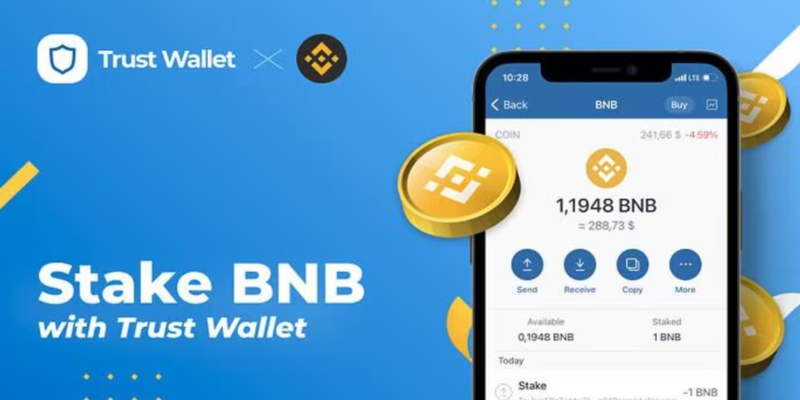
If you’re holding BNB and want it to work harder for you, staking is one of the easiest ways to start. You can stake BNB on Trust Wallet in just a few taps, without giving up control of your private keys the way you would on a centralized exchange. This guide from BNB Guides compares your staking options and shares practical tips to help you get better yields with fewer surprises along the way.
When you stake BNB on Trust Wallet, you’re delegating your tokens to a validator that helps secure the network. In return, you earn rewards paid in BNB, typically accrued on a regular schedule as long as your stake remains active.
The basic flow to stake BNB on Trust Wallet looks like this:
Staking through Trust Wallet is non-custodial, meaning your keys stay in your wallet the entire time. However, once you stake BNB on Trust Wallet, your tokens are locked until you unstake them, and unstaking typically involves a waiting period before funds become available again.
Tip: Always keep a small amount of unstaked BNB in your wallet to cover network fees for future transactions, including the transaction that unstakes your BNB later.
Before you commit, it’s worth comparing how staking through Trust Wallet stacks up against other options for putting your BNB to work.
| Method | Custody | Flexibility | Best For |
| Trust Wallet staking | Self-custody | Choose your own validator | Users who want control and mobile access |
| Centralized exchange staking | Custodial | Often simpler, fewer choices | Beginners who prioritize convenience |
| Direct validator delegation | Self-custody | Full control, more technical | Advanced users comfortable with wallets |
| Liquid staking protocols | Self-custody | Tradeable staked tokens | Users who want liquidity while staking |
Each method trades off convenience against control. If you value holding your own keys while still earning rewards, choosing to stake BNB on Trust Wallet sits in a good middle ground between exchange staking and manual validator delegation. It also avoids handing custody of your tokens to a third party, which matters more the longer you plan to stay staked.
Once you understand the basics, these tips can help you get more out of your staking strategy when you stake BNB on Trust Wallet:
Tip: Small, consistent adjustments to validator choice matter more than chasing the single highest advertised rate, since rates can fluctuate with network conditions and validator performance.
Staking isn’t risk-free, even through a reputable wallet. Before you stake BNB on Trust Wallet, keep these factors in mind:
None of these risks are unique to staking through Trust Wallet, but they’re worth weighing against the potential rewards before committing a large portion of your holdings.
Tip: Start with a smaller amount when you first stake BNB on Trust Wallet, then increase your position once you’re comfortable with how the process, timing, and rewards actually work.
Here’s a quick reference for the terms you’ll encounter when you stake BNB, useful to bookmark before your first transaction:
| Term | What It Means |
| Minimum stake | The smallest amount of BNB required to begin staking |
| Lock-up period | Time your BNB remains locked once staked |
| Unstaking period | Waiting time before unstaked BNB becomes available |
| Validator commission | Fee a validator takes from your rewards |
| APR / APY | Annual reward rate, shown live in the app and subject to change |
Rates and lock-up terms can shift based on network conditions, so always check the current figures inside the app before you stake BNB on Trust Wallet, rather than relying on numbers from an older guide or a third-party source.

Deciding to stake BNB on Trust Wallet comes down to balancing convenience, control, and risk. Compare validator options, understand the lock-up terms, and start small if staking is new to you.
With a bit of attention to validator performance and timing, choosing to stake BNB on Trust Wallet can be a straightforward way to earn steady rewards while keeping your BNB fully in your own hands, without relying on a centralized platform to hold your funds for you.

 Bitcoin (BTC) $ 81,845.00 1.8%
 Ethereum (ETH) $ 2,666.24 3.31%
 Tether (USDT) $ 0.999755 0.02%
 BNB (BNB) $ 769.66 2.85%
 XRP (XRP) $ 1.44 4.42%
 USDC (USDC) $ 0.999761 0.01%
 Solana (SOL) $ 112.43 3.54%
 TRON (TRX) $ 0.343205 0.22%
 Zcash (ZEC) $ 1,491.59 2.92%
 Figure Heloc (FIGR_HELOC) $ 1.00 0%