


To navigate the high-velocity landscape of Web3, setting automated BNB price alerts is no longer just an optional convenience but a foundational trading requirement. As we navigate 2026, the BNB Smart Chain continues to support billions in locked value across decentralized applications, which translates to immense market volatility.
By implementing professional-grade, multi-channel notification setups, you can remove the emotional fatigue of trading and make purely data-driven choices. This masterclass on BNB Guides explains the technical core of real-time price monitoring, outlines seven distinct alert strategies, and provides expert warnings to ensure your custom triggers never fail to execute when the market moves.
Before exploring advanced configuration setups, you must understand the technical architecture behind these notifications. At its core, a BNB price alert is a real-time tracking trigger configured to monitor market data streams from centralized order books or decentralized automated market makers.
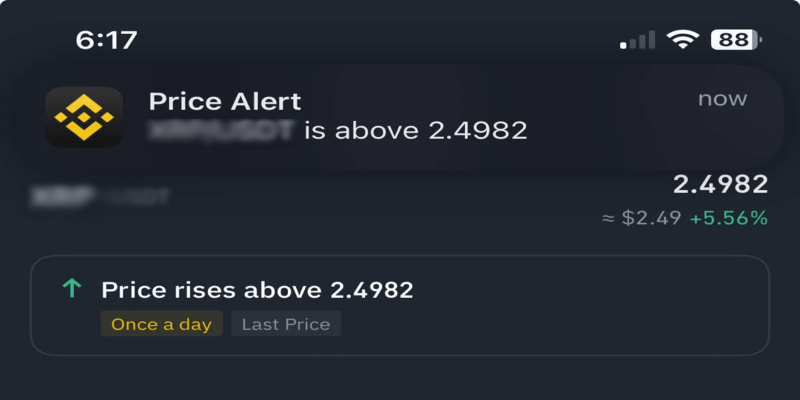
In decentralized finance, seconds make the difference between securing a highly profitable entry and getting caught in a cascading liquidation event. Understanding why real-time tracking is vital helps you design your alert thresholds with greater purpose.
To maximize your trading efficiency, you must utilize diverse monitoring strategies tailored to different market conditions. The following section outlines seven practical ways to configure your BNB price alerts in 2026:
The foundation of any notification setup is the standard price-crossing alert. Configure your system to ping you the second BNB crosses major psychological support or resistance levels (e.g., $600 or $650). This basic setup ensures you are awake for macro trend shifts without staring at screens.
Instead of tracking raw numbers, set alerts based on rapid percentage moves within a tight timeframe (e.g., a 3% shift in 10 minutes). This is highly effective for identifying sudden breakout momentum or catching flash crashes early.
Utilize technical indicators like the Relative Strength Index (RSI) to trigger your notifications. Setting alerts when the 4-hour BNB RSI dips below 20 (historically oversold) or climbs above 80 (overbought) helps you identify optimal reversal zones.
Price movement without volume is often a bull trap. Configure alerts that trigger when the trading volume of BNB on major exchanges increases by 200% above its 24-hour moving average. This indicates institutional participation and strong trend validation.

For critical support levels that protect your collateral from liquidation, standard push notifications might not be enough to wake you up at night. Utilize services like Cryptocurrency Alerting to trigger an actual phone call to your device when crucial price levels break.
Because BNB is the native gas token of the BNB Smart Chain, gas fee spikes correlate directly with high-demand on-chain events. Set alerts for when BSC gas fees exceed 10 Gwei, which often points to high-volume token mints, airdrops, or liquidations.
For advanced traders, link your BNB price alerts directly to trading execution bots via custom webhooks. When a price condition is met, the alert server sends a payload directly to your execution script to execute a market order instantly.
To successfully deploy these strategies, you need to choose the right platform based on your specific trading style. The table below compares the top operational alert systems available in 2026:
| Tool Category | Latency Range | Supported Channels | Best Use Case |
| Exchange-Native Alerts | Medium (1-5 seconds) | Push, In-app | Basic spot trading and quick manual executions |
| Cryptocurrency Alerting | Low (Sub-second) | Telegram, Discord, SMS, Phone | Complex multi-channel setups and webhook automation |
| TradingView Webhooks | Low (Sub-second) | Webhooks, Email, Push | Automated bot execution and technical script triggers |
| DeFi Pool Scanners | Variable (1-10 seconds) | Telegram, Webhooks | Tracking on-chain DEX pool imbalances and large trades |
To help you choose the best alert configurations for various market conditions, refer to the strategic action matrix below:
| Market Phase | Alert Strategy Priority | Primary Alert Setup | Target Action |
| Sideways Accumulation | Support/Resistance Targets | Simple price thresholds at range limits | Enter range-bound swing trades |
| Aggressive Bull Run | Volume Spikes & Breakouts | Volume + percentage change alerts | Ride high-momentum breakouts |
| Sharp Market Correction | Technical Oversold Metrics | 4-Hour RSI cross below 30 | Dollar-cost average into key zones |
| Systemic Debt Leverage | Collateral Safety Thresholds | Phone call alerts on liquidation boundaries | Add margin to debt positions |
Over 1-2% of all retail trading losses occur because users either ignore their own system signals or configure conflicting alert rules that result in notification fatigue. Avoid these common pitfalls:
Developing a robust system of BNB price alerts is the ultimate way to maintain your trading edge without sacrificing your peace of mind. By combining standard price thresholds with technical indicators and multi-channel delivery methods, you ensure that you are always ready to act when profitable setups present themselves.

 Bitcoin (BTC) $ 64,048.00 1.41%
 Ethereum (ETH) $ 1,868.86 3.02%
 Tether (USDT) $ 0.999248 0%
 BNB (BNB) $ 574.95 0.82%
 USDC (USDC) $ 0.999861 0%
 XRP (XRP) $ 1.09 2.15%
 Solana (SOL) $ 75.54 2.84%
 TRON (TRX) $ 0.322886 0.6%
 Figure Heloc (FIGR_HELOC) $ 1.04 0.08%
 Hyperliquid (HYPE) $ 62.58 7.78%