


If you’re holding tokens on Ethereum, Base, or another network and want to use them on BNB Smart Chain, you’ll need to bridge them first. To bridge to BNB Chain means moving assets from a different blockchain onto BNB Chain, so you can trade, stake, or use DeFi apps there. This guide from BNB Guides breaks down what bridging actually means and walks through the process step by step.
Different blockchains don’t talk to each other directly. Ethereum, Solana, and BNB Chain each run separate ledgers, so a token on one network can’t simply appear on another without help.
A bridge solves this. When you bridge to BNB Chain, the bridge protocol locks or burns your token on the source chain, then mints or releases an equivalent version on BNB Chain. The result is a token you can use inside BNB Chain’s ecosystem, even though your original asset technically never left its home network.
There are a few common bridge types:
Each method affects what you actually receive. A wrapped token isn’t always identical to a native one, so it’s worth checking which version a bridge delivers before you commit, especially if you plan to use that token in a specific DeFi app afterward.
Before you bridge to BNB Chain, a little preparation avoids most beginner mistakes.
Make sure you have:
Tip: Double-check that BNB Chain is already added as a network in your wallet before starting. Most modern wallets include it by default, but it’s worth confirming the chain ID and RPC details match official sources if you’re adding it manually.
Tip: If you’re bridging a stablecoin, confirm which variant the destination app expects. Some tokens exist as multiple wrapped versions on BNB Chain, and mixing them up can cause compatibility issues later.
The general process to bridge to BNB Chain looks similar across most bridge providers and aggregators:
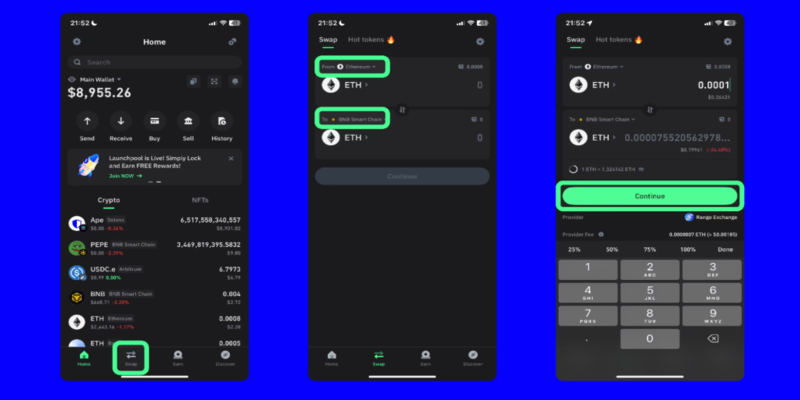
Delivery times vary depending on the source chain and route chosen, but many transfers settle within a minute or two once the source transaction confirms. Transfers from slower networks can take longer, since the destination side is rarely the bottleneck.
Tip: Always send a small test amount first, especially for larger transfers. Confirming the full process works end to end is worth the extra few minutes, and it can save you from a costly mistake on a much larger transaction.
There isn’t just one way to bridge to BNB Chain. Here’s how the main options compare:
| Method | Custody | Speed | Best For |
| Centralized exchange withdrawal | Custodial | Fast, no bridge risk | Users who already hold funds on an exchange |
| Onchain bridge protocol | Non-custodial | Minutes, depends on source chain | Users who want to stay in their own wallet |
| Bridge aggregator | Non-custodial | Routes to the fastest/cheapest option | Users comparing multiple providers at once |
| Liquidity-pool based bridge | Non-custodial | Often near-instant | Smaller transfers where speed matters most |
If you already hold funds on a centralized exchange, withdrawing directly to BNB Chain is usually the simplest route and skips bridge risk entirely, since no third-party protocol sits between you and your funds. If you’re starting from a self-custody wallet on another chain, an aggregator is often the easiest way to compare routes without researching each individual bridge yourself.
It’s also worth noting that fees and speed can shift depending on network congestion, so the fastest or cheapest option today might not be the best choice next week. Checking a live quote before confirming is always safer than relying on a fee estimate from an older guide.
Bridging carries some risks that are worth understanding before you move meaningful amounts. When you bridge to BNB Chain, keep these in mind:

Tip: Stick to bridges with public audit reports and a track record of reliable transfers, especially for larger amounts. Newer or unaudited bridges carry meaningfully more risk, even if they advertise lower fees.
Understanding what it means to bridge to BNB Chain comes down to recognizing that you’re moving value across separate, independent networks, not just clicking a button. Whether you choose a centralized exchange withdrawal, an onchain bridge, or an aggregator, the fundamentals stay the same: confirm the network, check the token variant, and keep enough BNB on hand for gas.
With those basics covered, bridging becomes a routine part of using BNB Chain’s DeFi apps, token launches, and broader ecosystem, without much friction once you’ve done it a few times. Taking the extra minute to verify each detail now will save far more time and money than fixing a mistake after the fact.

 Bitcoin (BTC) $ 78,577.00 0.6%
 Ethereum (ETH) $ 2,471.74 1.38%
 Tether (USDT) $ 0.999793 0.01%
 BNB (BNB) $ 690.33 0.65%
 XRP (XRP) $ 1.38 0.66%
 USDC (USDC) $ 0.999884 0%
 Solana (SOL) $ 103.09 0.25%
 TRON (TRX) $ 0.331720 1.47%
 Figure Heloc (FIGR_HELOC) $ 1.00 0%
 Hyperliquid (HYPE) $ 83.44 2.99%