


Finding the right BNB trading strategies matters more in a market that moves as fast as this one. Between BNB Chain’s ongoing network upgrades, quarterly token burns, and BNB’s tight correlation with Binance-specific news, traders have several distinct angles to work with. This breakdown from BNB Guides covers three practical approaches worth understanding before you place your next trade.
This article is for educational purposes only and isn’t financial advice. Trading involves risk, and you should do your own research before making decisions.
Not every approach works equally well for BNB. Unlike smaller altcoins, BNB responds to a highly unique mix of technical signals and ecosystem-specific catalysts, which means the most effective BNB trading strategies usually combine more than one signal type.

A few factors make BNB distinct:
Because of these unique network drivers, traders often blend chart-based setups with awareness of upcoming auto-burn events or launchpool schedules. Relying on price charts alone tends to miss the bigger fundamental picture. Before applying any BNB trading strategies, check whether an ecosystem event or burn is upcoming, as these shifts actively dictate market momentum.
Swing trading remains one of the more accessible BNB trading strategies, especially for active market participants who cannot watch chart patterns constantly. This methodology focuses on capturing price swings over several days or weeks.
To execute this setup effectively, keep these core steps in mind:
This swing style performs best when BNB trends clearly in one direction rather than chopping sideways. News-driven events, such as network upgrades or shifts in Binance sentiment, often trigger the precise medium-term trends swing traders look for.
As a professional tip, always combine your swing entries with volume confirmation. A breakout or pullback on low volume is highly likely to fail, whereas strong volume indicates heavy participation and validates your active BNB trading strategies.
Breakout trading focuses on capturing sharp moves when BNB pushes through a well-established support or resistance level.
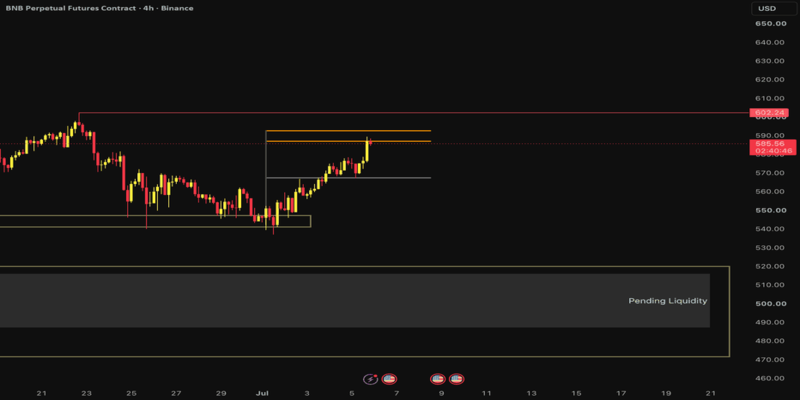
This is one of the more active BNB trading strategies, suited to traders comfortable monitoring price action closely.
Key elements of a breakout approach:
False breakouts are common in crypto markets, including BNB, so confirmation matters more than speed. Entering too early on a weak breakout often leads to getting stopped out before the real move develops.
Tip: Wait for a full candle close beyond the level, rather than reacting to an intrabar spike, to reduce the chance of chasing a fakeout.
Because BNB’s tokenomics directly affect supply, some of the most distinct BNB trading strategies focus on ecosystem events rather than pure chart patterns.
Here’s how the three strategies covered in this guide compare:
| Strategy | Time Horizon | Best Suited For |
| Swing trading | Days to weeks | Traders following medium-term trend direction |
| Breakout trading | Hours to days | Active traders reacting to key level breaks |
| Ecosystem-driven trading | Days to weeks | Traders positioning around burns and network catalysts |
Ecosystem-driven trading involves watching for scheduled token burns, major protocol upgrades, or announcements tied to BNB Chain’s roadmap. These events can create demand spikes or shift sentiment independent of pure technical setups.
Tip: Track BNB Chain’s public roadmap and burn schedule directly, rather than relying solely on secondhand commentary, to time entries around known catalysts more accurately.
Whichever approach you choose, disciplined risk management determines whether your system actually holds up over time. To protect your portfolio, you must implement strict defensive rules regardless of which BNB trading strategies you use.
As a final tip, always backtest on historical price data or paper trade first before committing real capital to any new BNB trading strategies. Consistently managing your downside is the only way to survive and thrive in volatile markets.
Effective BNB trading strategies usually combine technical structure with awareness of BNB’s unique ecosystem dynamics, rather than relying on chart patterns alone. Swing trading, breakout trading, and ecosystem-driven positioning each offer a different way to approach the same market.
No single strategy guarantees results, and market conditions shift constantly. Testing an approach carefully, sizing positions sensibly, and staying disciplined through losing trades matters more than picking the “perfect” strategy from the start.

 Bitcoin (BTC) $ 77,937.00 0.22%
 Ethereum (ETH) $ 2,433.82 0.86%
 Tether (USDT) $ 0.999847 0.01%
 BNB (BNB) $ 686.10 1.14%
 XRP (XRP) $ 1.36 2.11%
 USDC (USDC) $ 0.999844 0.01%
 Solana (SOL) $ 102.47 2.33%
 TRON (TRX) $ 0.336747 1.22%
 Figure Heloc (FIGR_HELOC) $ 1.00 0%
 Hyperliquid (HYPE) $ 80.89 2.56%